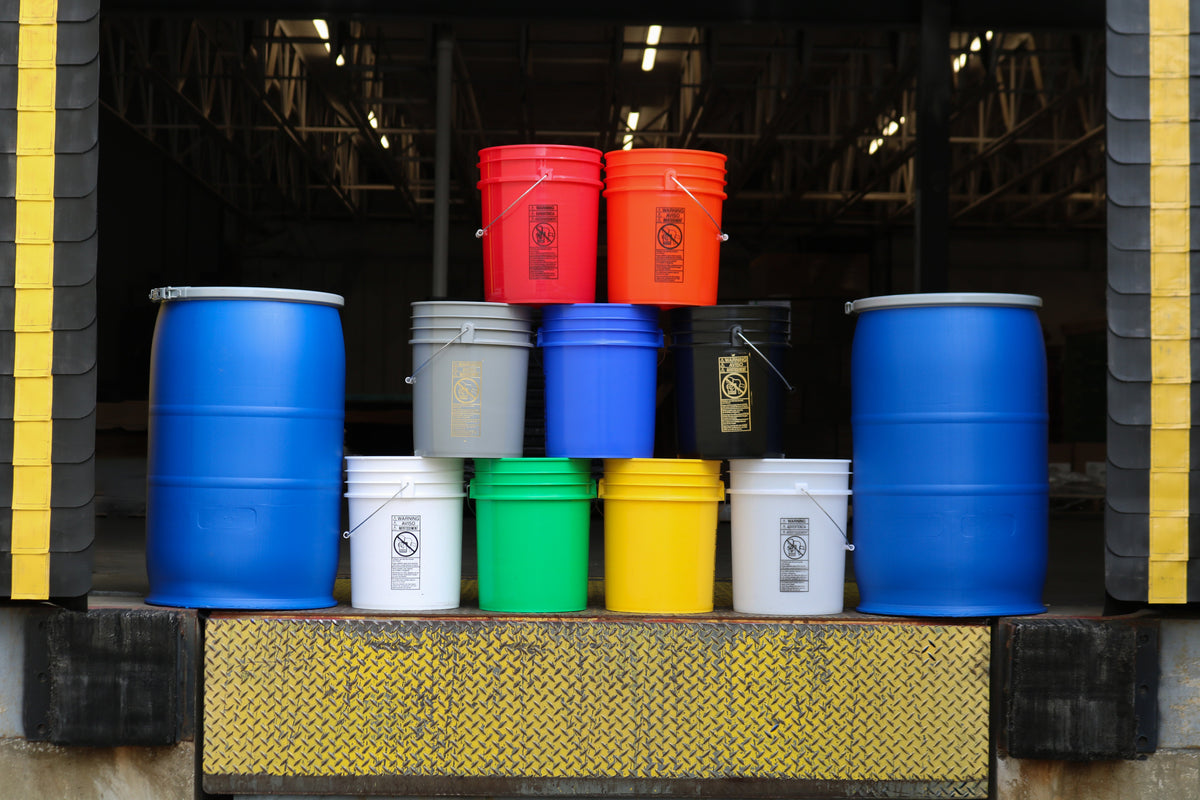
A set of food-grade buckets tends to end up doing a lot more than holding rice. You might buy a 6-pack for long-term food storage, then find yourself filling one with chicken feed, planting potatoes in another and keeping one by the back door for grill pellets.
The ideas below come from customers who bought our 5 gallon buckets and wrote about how they use them. So many of these uses touch food, water or animals, which is why it matters that your buckets are food-grade. For bucket basics like lid types, wall thickness and storage temperatures, see our Long Term Food Storage Guide.
Our 5 gallon buckets have more than 1,700 written reviews on Amazon and a 4.7-star rating. When you order from us, you get the buckets, the right lids for how you'll use them and custom printing if you need it, all from one place.
Long-Term Food Storage and Emergency Prep
Food storage is still the most common reason people buy our buckets. Reviewers use them to store rice for emergencies, seal dry goods in Mylar bags with oxygen absorbers inside the bucket, keep grains on hand for a small food business and protect pantry staples from mice and bugs.
If you've looked at the pre-made emergency food buckets in stores right now, building your own is worth comparing.
| Store-Bought Kit | Building Your Own | |
|---|---|---|
| Menu | Set by the brand | Foods your household already eats |
| Dietary needs | Limited options | You choose: gluten-free, lower sodium, kid-friendly |
| Rotation | Usually stays sealed until an emergency | Rotate staples into everyday meals |
| Buckets | One bucket, then it's done | Six buckets to fill and reuse |
Serving counts can also be misleading. A popular 150-serving kit adds up to about 25,000 calories, which is roughly 12 days of food for one adult at 2,000 calories a day. When you build your own, you decide how long your supply lasts.
Sorting your supply by bucket makes it easier to find what you need and see what's running low.
-
Staples
Rice, dried beans, oats, pasta, sugar and salt. Seal grains and beans in Mylar with oxygen absorbers for long-term storage.
-
Ready Meals
Freeze-dried meals and just-add-water sides for days when cooking from scratch isn't realistic.
-
First Aid and Hygiene
Bandages, medications, wipes, soap, toothbrushes and trash bags.
-
Power Outage
Flashlights, batteries, a battery-powered radio, phone power banks, matches and a manual can opener.
If you're starting from scratch, our 5 gallon food storage buckets with lids come as a 6-pack: six buckets and six gasketed tear-strip lids in one matching color. The lids press on to keep out moisture, dust and pests, the tear strip shows whether a bucket has been opened since you packed it, and the recessed lids let full buckets stack steadily on a shelf.
Order sets in different colors and you can tell what's in each bucket from across the room.
💡 Helpful Tip: Keep the gasketed tear-strip lids on the buckets you won't open for a long time, and swap a gamma seal lid onto the one you open every week.
For sealing steps and shelf life by food, see our Long Term Food Storage Guide.
Emergency Water and Saving Water
Water is the next most common use. One reviewer kept full buckets of emergency water through the winter, and when they froze solid, the buckets held up fine. Another built a homemade gravity water filter and chose food-grade buckets over hardware store buckets to do it. On a septic system, one customer catches the water that runs while the shower warms up and uses it to refill the toilet tank.
After Hurricane Helene knocked out power, one customer set a bucket of water in the sun so she'd have warm water to bathe her 103-year-old mother.From a review of our 5 gallon bucket 6-pack
For drinking water, use a bucket with a gasketed lid, like our 6-pack with gasketed tear-strip lids, or our tight head containers, which seal with a screw cap. Our Long Term Food Storage Guide walks through the steps for storing water.
If your water buckets might freeze, leave a little space at the top so the water has room to expand.
Dog Food, Chicken Feed and Animal Feed
A bucket keeps feed dry and away from rodents. Reviewers use ours for dog food, and one has stored chicken feed and water in them for several years with the buckets still in good shape. Another keeps a bucket of dog food by the door that doubles as a seat.
💡 Helpful Tip: Put a gamma seal lid on your feed bucket. Since you'll scoop from it every day, a lid that screws on and off by hand saves you from prying it open each time.
Gardening and Hydroponics
Our buckets show up in a lot of gardens. One reviewer grows potatoes in a small backyard. Another started a six-bucket flower garden indoors in late winter and moved it outside in May. Indoor growers use them to mix and store nutrient solution for hydroponic systems.
Growers also point out that black buckets block light, which keeps algae from growing inside. Our 5 gallon bucket comes in black, along with eight other colors. For soil, drainage and what to plant, see Growing Vegetables in 5-Gallon Buckets.
Honey, Homebrew and Fermenting
Beekeepers use our buckets for extracting and storing honey, and home brewers use them for brewing, pickling and fermenting. Since you're working with something you'll eat or drink, a food-grade bucket matters here more than almost anywhere. If you bottle your honey, take a look at our beekeeping supplies.
Around the House and Yard
Once you have a 6-pack, a few buckets usually end up outside the pantry. Here's where reviewers put theirs.
Grill Pellets
About 30 pounds of wood pellets per bucket, kept dry next to the pellet grill.
Car Washing
One bucket for soapy water and one for rinsing.
Trash Cans
A lidded bucket works as a small trash can in the garage or shed.
Side Table
Flip a lidded bucket over and it's a small table on the porch.
Drum Set
One set of buckets became drums for a reviewer's grandkid.
Seating
A full, lidded bucket makes a sturdy seat in the yard or barn.
How to Put On and Take Off Bucket Lids
Lids are the thing reviewers mention most, and a few simple steps make them much easier to work with.
-
1
Pull off the tear-strip band before you put the lid on the first time.
-
2
Set the bucket on a hard floor and tap around the rim with a rubber mallet until the lid seats all the way.
-
3
To open the bucket, lift each tab around the edge or use a bucket lid opener.
-
4
If you'd rather screw the lid on and off, swap in a gamma seal lid.
For the full steps with photos, see How to Install Bucket Lids.
Need Buckets for a Church, Pantry or Team?
If you're putting together emergency kits for a congregation, a food pantry, your employees or your customers, custom printed 5 gallon buckets let you put your logo, a contents list and instructions right on the bucket. We print in-house in Evansville, Indiana, and our design team can help set up your artwork.
Frequently Asked Questions
Are Black Buckets Good for Hydroponics?
Yes. Black buckets block light, which keeps algae from growing in your nutrient solution. Pick a food-grade bucket so nothing leaches into the water your plants take up.
How Should I Store Dog Food in a Bucket?
Pour the food into a clean, dry food-grade bucket, or set the whole bag inside, and close it with a gamma seal lid so you can open it by hand every day. Keep it somewhere cool and dry, and wash the bucket out between bags.
How Many Pounds of Wood Pellets Fit in a 5 Gallon Bucket?
Reviewers report about 30 pounds per bucket. A lid keeps the pellets dry, which matters since damp pellets can swell and crumble.
Ready to Put Your Buckets to Work?
Shop food-grade 5 gallon buckets in 6-packs, or request a quote on custom printed buckets for your group.
Prefer to talk it through? Call 888-853-2452 or contact us.